
In more than 25 years of moving pets, the single most common reason a shipment gets turned away at the airport is not paperwork. It is the kennel. The pet is healthy, the documents are in order, the flight is booked, and then a check-in agent looks at the crate and says no. We want to help set the record straight and guide you the right airline approved kennel.
One of the most frustrating situations we’ve seen is that most of these rejections happen to owners who bought a crate labeled “airline approved.” That phrase is marketing language. It is not a certification, and no authority issues it. What actually governs the decision is the International Air Transport Association’s Live Animals Regulations, specifically Container Requirement 1 (CR1). This guide covers exactly what CR1 requires, what gets rejected on sight, and how to size a kennel correctly the first time.
Why “airline approved” means nothing on its own. IATA states plainly that it does not certify, approve, endorse, or sell any particular pet container manufacturer, brand, make, or model. No crate on the market carries an official IATA seal of approval. A crate either meets the CR1 standards or it does not, and the check-in agent makes that call on the day. Source: IATA Live Animals Regulations, Container Requirement 1 (Edition 52, January 2026).
What Is an IATA Approved Pet Kennel?
An IATA compliant kennel is one that meets Container Requirement 1 of the IATA Live Animals Regulations, the global standard that the large majority of commercial airlines follow for transporting dogs and cats. CR1 sets out requirements for construction, size, ventilation, doors, fasteners, flooring, spacers, handles, bedding, and labeling.
Two things are worth understanding before you shop:
- CR1 applies to both cargo and cabin, with exceptions. For pets in the aircraft hold, the full rigid-construction standard applies. For in-cabin travel, IATA allows the container to be non-rigid, drops the spacer requirement, and does not require food and water containers or a welded wire mesh end panel for soft-sided bags.
- Airlines can be stricter than IATA, never looser. CR1 is the floor, not the ceiling. Individual carriers add their own limits on dimensions, materials, and breeds. Always confirm with the operating airline before you buy.
What Kennels Will Airlines Reject Immediately?
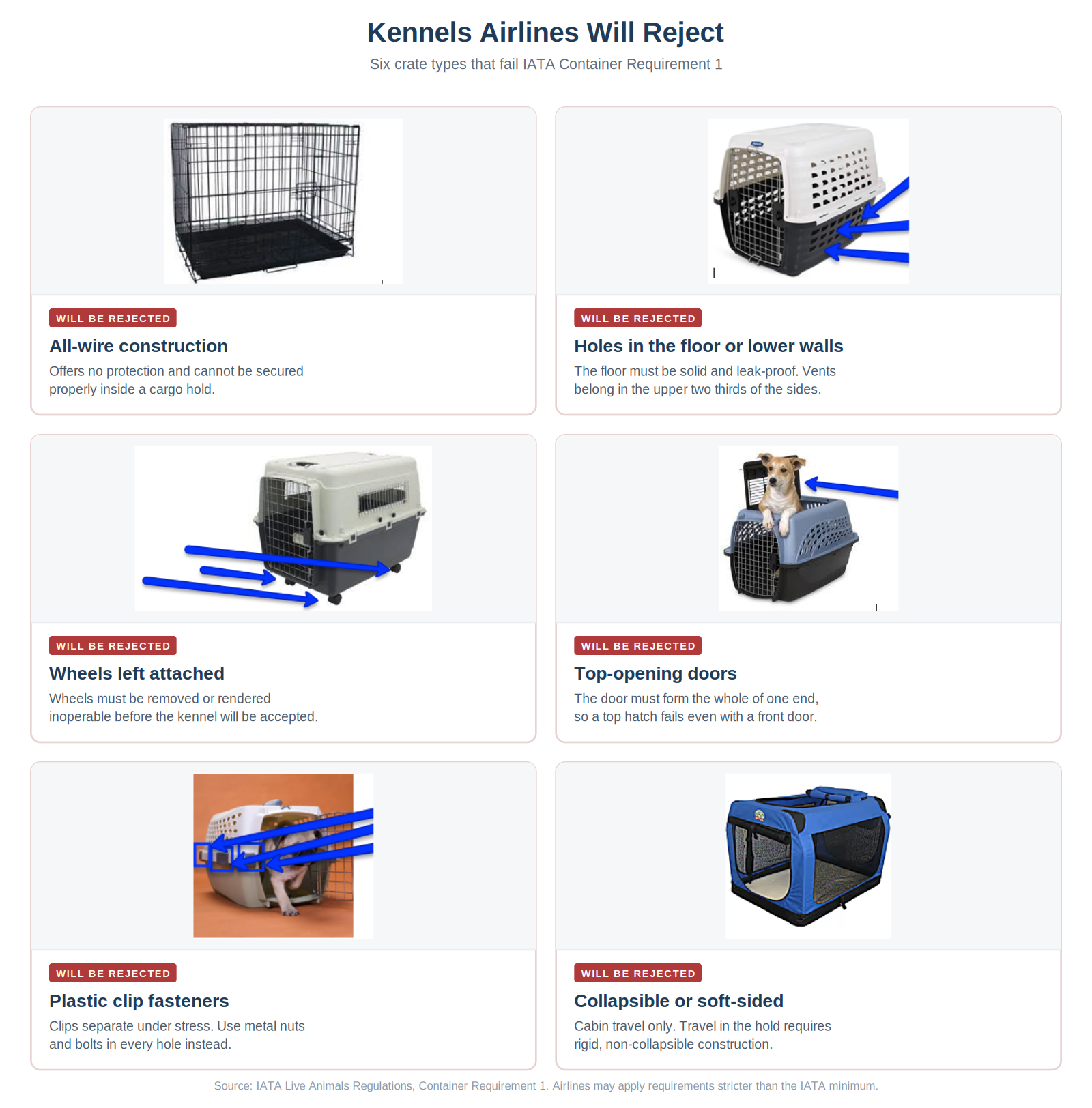
These are the crates we most often see turned away. Each one fails a specific CR1 requirement, so there is no negotiating at the counter.
| Kennel feature | Why it gets rejected | What IATA says |
| All-wire construction | Flimsy, offers no protection, and cannot be secured properly in a cargo hold. | Containers made entirely of welded wire mesh, or any wire mesh, must not be used for air transport. |
| Holes in the floor | The most common rejection we see. Compromises structural integrity and leaks. Sold widely, including by major brands. | The floor must be solid and leak-proof. |
| Wheels | The kennel slides around the hold in flight and during loading. | If a container has wheels, they must be removed or rendered inoperable. |
| Top-opening doors | Top doors can pop open under handling, creating an escape risk. | The door must form the whole of one end of the container. |
| Plastic clip fasteners | Clips separate under stress, so the top and bottom halves can come apart. | Plastic clips must not be the only fasteners holding the top and bottom together. Metal nuts and bolts in every hole are recommended. |
| Collapsible or soft-sided (for cargo) | Soft carriers are for in-cabin travel only. They cannot protect a pet in the hold. | CR1 requires rigid construction for hold travel. The non-rigid exception applies only to in-cabin carriers. |
 The one that catches almost everyone: holes in the floor. Many popular plastic kennels ship with a perforated or grated floor pan. They are perfectly good crates for home and car use, and they are sold by reputable manufacturers, which is exactly why owners assume they are fine for flying. IATA requires a solid, leak-proof floor. If you can see through the bottom of your kennel, it will not fly.
What Are the IATA Kennel Requirements for 2026?
Here is the full CR1 standard in plain language, drawn directly from Edition 52 (January 2026).
Construction and materials
- Acceptable materials are fiberglass, metal, rigid plastics, welded wire mesh, solid wood, or plywood. Wood used for international transport must comply with IPPC standards.
- The interior must be smooth, with no protrusions the animal can bite or scratch.
- All openings must be nose and paw proof. Maximum opening size is 25 mm x 25 mm for dogs and 19 mm x 19 mm for cats.
- Welded wire mesh must be at least 2.5 mm thick for dogs and 2.0 mm for cats.
- Wooden containers need side thickness of at least 12 mm for dogs and 6 mm for cats, with a 12 mm roof for both.
Sides, floor, and roof
- Side walls must be solid, with ventilation as prescribed below.
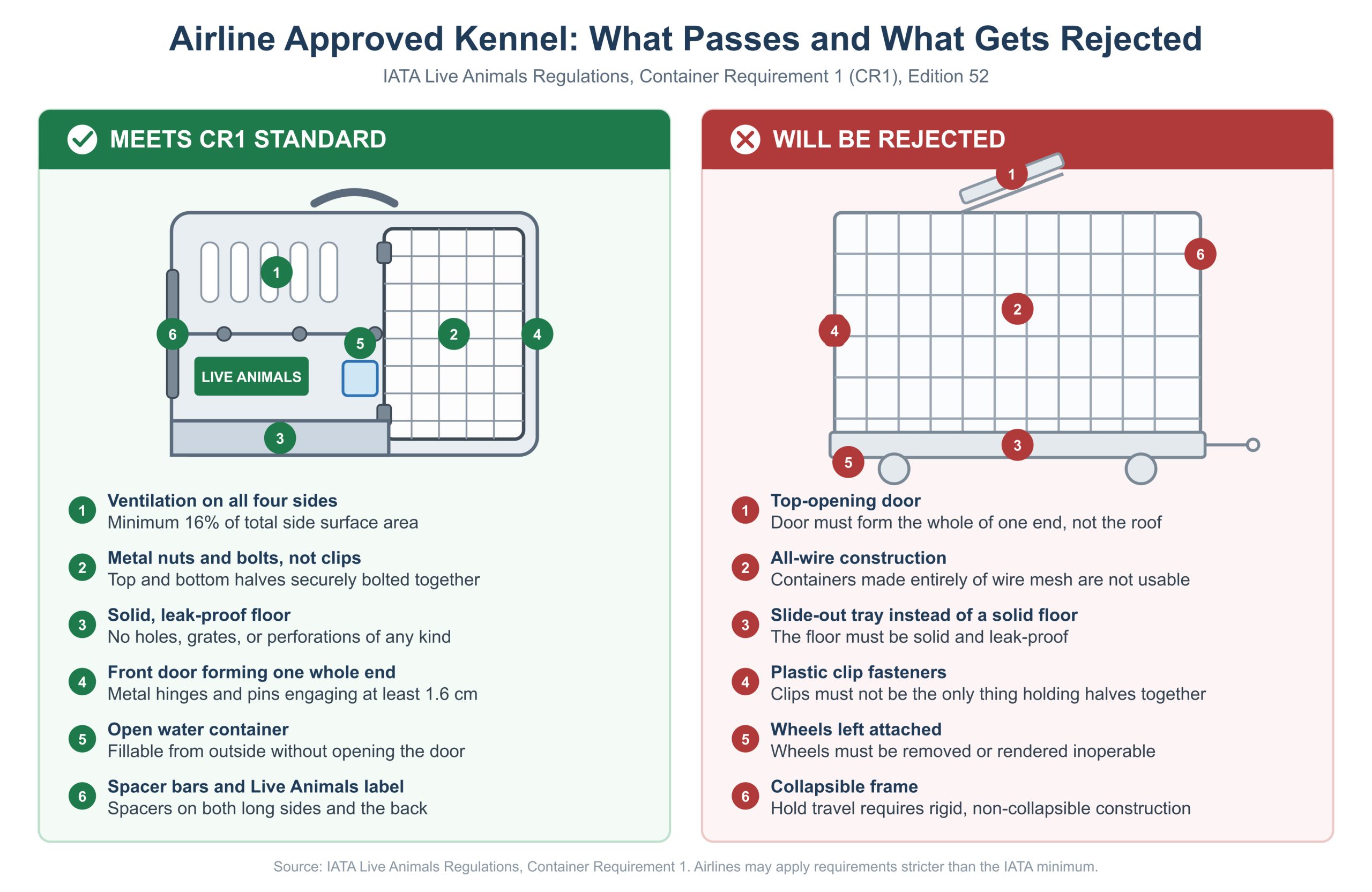
- Where a plastic kennel is assembled from a top and bottom half, those halves must be securely bolted together. Plastic clips alone are not acceptable, and IATA recommends metal nuts and bolts in every hole.
- The floor must be solid and leak-proof.
- The roof must be solid, though ventilation openings and mesh are permitted provided they do not weaken it.
Door
- The door must form the whole of one end of the container, and can be sliding or hinged.
- It must be built of plastic, wood, plywood, or welded or cast metal thick enough that the animal cannot bend or distort it.
- Locking pins must engage the container by at least 1.6 cm.
- On plastic doors, hinges and locking pins must be metal of sufficient thickness.
- IATA recommends securing rigid plastic kennel doors further with removable fasteners such as cable ties at the four corners of the door frame.
Ventilation
- Total ventilated area must be at least 16 percent of the total surface of the four sides.
- Ventilation must be provided on all four sides.
- Openings on the sides and back must sit in the upper two-thirds of the container.
- The whole of one end (which can be the door) must be welded wire mesh.
- Mesh inserts must be fixed so the animal cannot dislodge them.
Four sides, not three. You will see plenty of older guidance, including some airline pages, referring to ventilation on three sides. CR1 in the current edition requires ventilation on all four sides for dogs and cats, with a minimum of 16 percent of the total side surface area. If you are comparing a kennel against an out-of-date checklist, this is a detail that can cost you at check-in.
Spacers, handles, and forklift clearance
- Spacers must be fitted along both long sides and along the back, positioned so other freight cannot block airflow.
- Appropriate handles must be provided so handlers can move the kennel without risk of being scratched or bitten. Spacers can serve as handles where suitable.
- Forklift spacers of at least 5 cm are required when the total weight with the animal exceeds 60 kg (132 lb).
Bedding, food, and water
- Absorbent bedding suitable for the species must be provided.
- A water container must be affixed inside the kennel with outside access for filling, so staff can top it up without opening the door.
- Water bottles and similar dispensers do not satisfy this requirement. IATA specifies open containers, securely affixed so they cannot be dislodged.
- Food containers must be present inside (if sealed) or attached to the outside. Food can be attached to the kennel for use in case of delay.
Labeling
- A green “Live Animals” label or tag is mandatory.
- “This Way Up” labels are mandatory on at least two opposite sides.
- IATA recommends marking the animal’s name on the container.
How Do I Measure My Dog for a Flight Kennel?
Size is the second most common rejection trigger after construction, and it is entirely preventable. The mandatory performance standard is simple: your pet must be able to stand, sit erect, lie in a natural position, and turn around normally while standing. If a check-in agent thinks the pet cannot do all four, the kennel is refused.
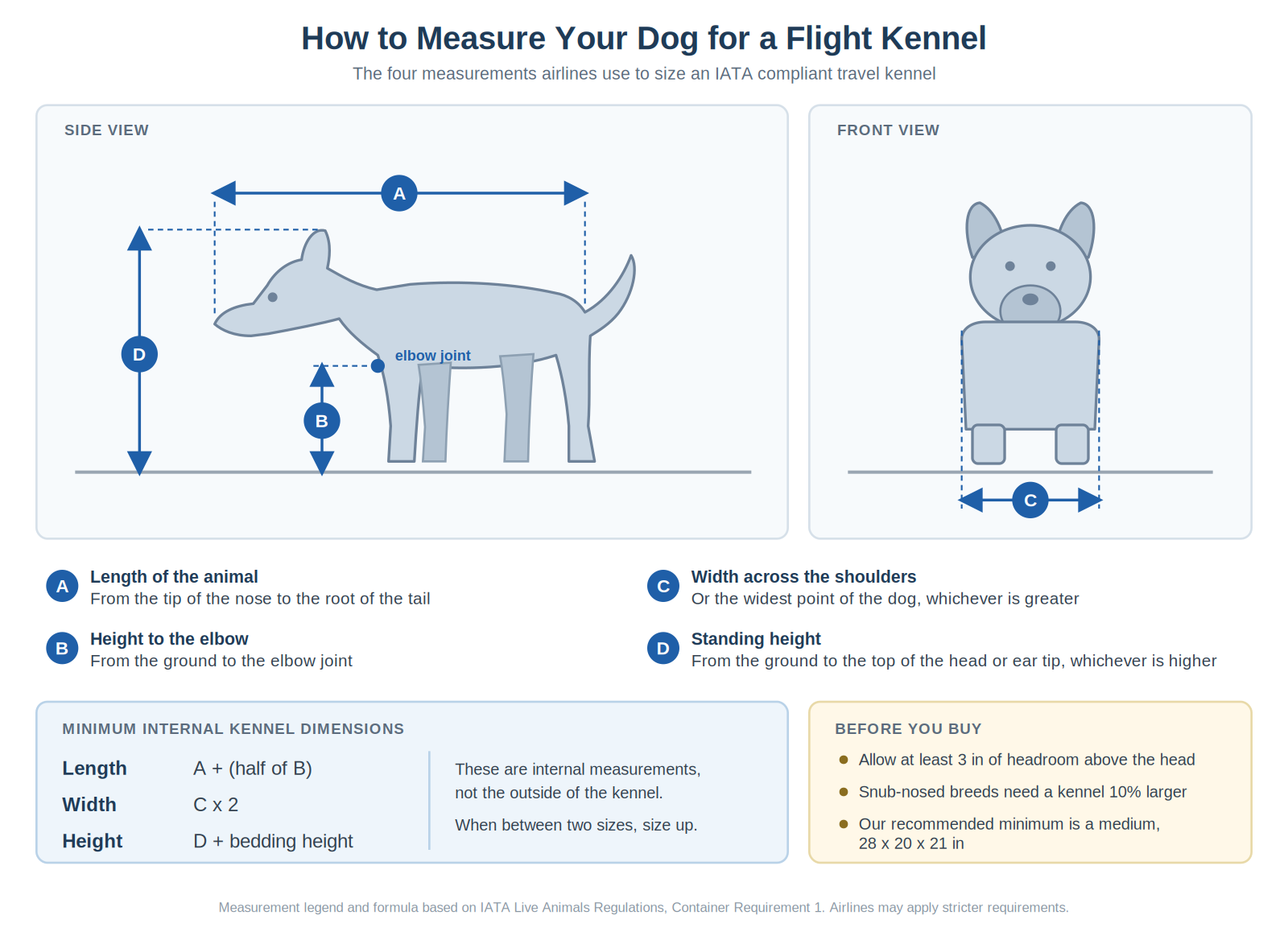
IATA provides a formula to get you close. Take these four measurements first:
| Measurement | How to take it |
| A | Length of the animal from the tip of the nose to the base (root) of the tail. |
| B | Height from the ground to the elbow joint. |
| C | Width across the shoulders, or the widest point, whichever is greater. |
| D | Height of the animal standing naturally, measured from the floor to the top of the head or the ear tip, whichever is higher. |
Then calculate the minimum internal dimensions:
| Internal dimension | Formula |
| Length | A + (half of B) |
| Width | C x 2 |
| Height | D + the height of the bedding |
A few things the formula does not tell you on its own:
- Bedding counts toward height. Measure your pet standing, then add the thickness of the bedding you plan to use. A crate that fits without bedding may fail with it.
- Snub-nosed breeds need 10 percent more. IATA requires a 10 percent larger container for brachycephalic breeds. If your pet is a Pug, Bulldog, Boxer, Persian, or similar, size up. See our guide on flying with snub-nosed breeds before you buy anything.
- These are internal measurements. Manufacturer listings often quote external dimensions. The difference matters, especially on smaller kennels.
- Round up, not down. When you fall between two sizes, take the larger one. Too big is an inconvenience. Too small is a rejection.
For a full walkthrough with worked examples, see our companion guide, How to Measure Your Dog for a Flight Kennel.
Can Two Pets Share One Kennel?
Sometimes, within strict limits. IATA permits a maximum of two adult animals of comparable size, up to 14 kg each, that are compatible and used to living together. Animals over 14 kg must be crated individually.
For puppies and kittens, they must be no older than six months, weigh no more than 14 kg each, number no more than three per container, and be used to cohabiting. Note that some national regulations require dogs and cats to be crated individually regardless, unless the shipment is a litter over eight weeks old traveling with its mother.
When multiple animals share a kennel, the width formula changes: use C x 3 for two animals and C x 4 for three. Length and height are calculated the same as for a single animal.
What Else Should I Know Before Travel Day?
CR1 covers more than the box itself. A few preparation rules come straight from the same regulation and are worth knowing.
Do not sedate your pet. IATA does not recommend tranquillization or sedation of dogs and cats. Most common tranquillizers lower blood pressure, which also happens naturally at altitude, since cabin pressure is set at roughly the equivalent of 8,000 feet. IATA describes the combination of altitude and these drugs as potentially fatal in older, chronically ill, or stressed animals. If sedatives are used under veterinary direction, the drug name, time, and route of administration must be marked on the container and documented with the shipment.
- Age limits. Weaned puppies and kittens younger than eight weeks must not be shipped, due to dehydration risk in air transport.
- Pregnancy and nursing. Dogs and cats should only be shipped during the first two-thirds of pregnancy, and not for seven days after giving birth. Females with suckling young and unweaned animals are not accepted.
- Feed a light meal at least two hours before dispatch, offer a short drink, and exercise your pet immediately before crating. Animals should not fly within two hours of a meal. Water must be provided if the total journey exceeds 12 hours.
- Remove gear. IATA recommends removing collars, harnesses, vests, clothing, and GPS trackers before crating. Any tracker used must comply with IATA Dangerous Goods Regulations and be declared to the operator.
- Add something familiar. A familiar article in the kennel helps settle the animal.
Acclimate the kennel weeks in advance, not days. Buy the kennel early and let your pet sleep in it at home with the door open, then with the door closed for short periods. A pet that already treats the crate as a safe space travels far better than one meeting it for the first time at the airport. Our guide on how to treat dog travel anxiety has more on easing the transition.
Which Kennel Should I Buy?
We have long recommended the Petmate Sky Kennel as the most reliable off-the-shelf option for cargo travel. In our experience, it consistently meets airline expectations, it is widely stocked at major pet retailers, and its dimensions map cleanly to the standard 100 through 700 series sizing that airlines are used to seeing.
Two caveats worth stating plainly. First, buying a Sky Kennel does not guarantee acceptance. You still need the correct size for your pet, and depending on the model and route, you may need to add metal nuts and bolts in every hole, fit a solid floor if yours is perforated, and secure the door corners with cable ties. Second, very large or powerful dogs may need a custom wooden kennel built to CR1 wooden-container specifications, because IATA notes that rigid plastic containers may not be suitable for large or aggressive dogs and acceptability is at the operator’s discretion.
Before you buy anything, confirm three things: (1) your pet’s four measurements and the resulting internal dimensions, (2) whether your breed faces any airline restriction, and (3) your specific airline’s published kennel limits, which can be tighter than IATA’s. Getting these in the right order saves buying a kennel twice.
Does the Kennel Matter for In-Cabin Travel Too?
Yes, though the standard is different. For cabin travel the container still needs to meet CR1 in general terms, but IATA relaxes several requirements: construction does not have to be rigid, spacers are not required, food and water containers are not required, and the welded wire mesh end panel does not apply to soft-sided bags. The Live Animals label is still required and must not block ventilation.
The practical constraint in the cabin is under-seat space, which varies by aircraft. IATA notes that soft-sided containers can compress when pushed under a seat, and that compressing the ventilation openings can reduce airflow and cause heat buildup. That is a real risk, not a technicality. For cabin-specific rules and current airline fees, see our guide to pets as carry-on luggage.
What If My Pet Is Traveling as Cargo?
Most international relocations move pets as manifest cargo rather than in the cabin, and the kennel standards above apply in full. Worth knowing: United has discontinued its PetSafe cargo program for the general public, with narrow exceptions for active-duty U.S. military and State Department Foreign Service personnel, which has reshaped routing options for large dogs in recent years. Confirm your carrier’s current cargo status early, because it affects which kennel size and material will work on your route.
Our Ultimate Guide to Pet Cargo and Air Freight for Dogs and Cats explains how cargo travel works end to end, and why use a pet moving service covers when coordination is worth handing off.
Kennel Compliance Checklist
Run through this before travel day. Every item traces back to CR1.
- Rigid construction in an approved material, with no wire-only build
- Solid, leak-proof floor with no holes or grates
- Top and bottom secured with metal nuts and bolts, not plastic clips
- Front-opening door only, forming the whole of one end, with metal hinges and locking pins engaging at least 1.6 cm
- Ventilation on all four sides totaling at least 16 percent of side surface area, in the upper two thirds
- Wheels removed or disabled
- Spacers on both long sides and the back
- Secure handles for ground handlers
- Open water container affixed inside with outside filling access, plus a food container
- Absorbent bedding in place
- Green “Live Animals” label plus “This Way Up” labels on two opposite sides
- Pet can stand, sit erect, turn around, and lie naturally, with bedding in
- Snub-nosed breed sized up by 10 percent if applicable
- Cable ties on the four door corners for rigid plastic kennels
Not sure your kennel will pass? If you are relocating with us, your pet relocation specialist reviews your kennel choice against your specific airline and route before you buy. Request a price quote and we will confirm the right size and specification for your pet, so travel day is not the first time anyone inspects the crate.
IATA updates the Live Animals Regulations annually, and individual airlines may impose requirements stricter than the IATA minimum. The specifications in this article reflect Container Requirement 1, Edition 52 (January 2026), verified in August 2026, and are provided as general guidance. Always confirm current kennel requirements with your operating airline before purchasing a kennel or booking travel.