
In This Guide:
- Why Microchips Are Required
- What Is a Microchip & How It Works
- ISO vs. Non-ISO Differences
- When to Microchip (Timing Matters)
- International Registration
- How Microchips Are Checked
- Requirements by Country
- Frequently Asked Questions
Why Microchips Are Required for International Pet Travel
International pet travel is a tightly regulated process designed to prevent the spread of disease and ensure animals can be accurately identified at every stage of the journey. At the center of that system is the microchip. For most countries, a microchip is not optional. It is a legal requirement that links your dog to its vaccination records, health certificates, and import documentation. Without it, authorities have no reliable way to verify that the dog entering the country is the same one listed on official paperwork.
This becomes especially important when dealing with rabies control. Many destinations, including countries like the United Kingdom, France, and Australia, require proof that a dog’s rabies vaccination was administered after a valid microchip was implanted. The microchip number is recorded on all veterinary documents, creating a traceable link between the animal and its medical history.
Microchips are also used at multiple checkpoints throughout the travel process. Veterinarians scan them before issuing health certificates, airline staff may verify them during check-in, and border officials often scan them again upon arrival. If the chip cannot be read or doesn’t match the documentation, it can result in delays, quarantine, or even denied entry.
Key Takeaway: The microchip acts as your dog’s permanent, internationally recognized ID, ensuring that every document, vaccine, and clearance is tied to the correct animal. Without it, the entire travel process can break down.
What Is a Pet Microchip and How Does It Work?
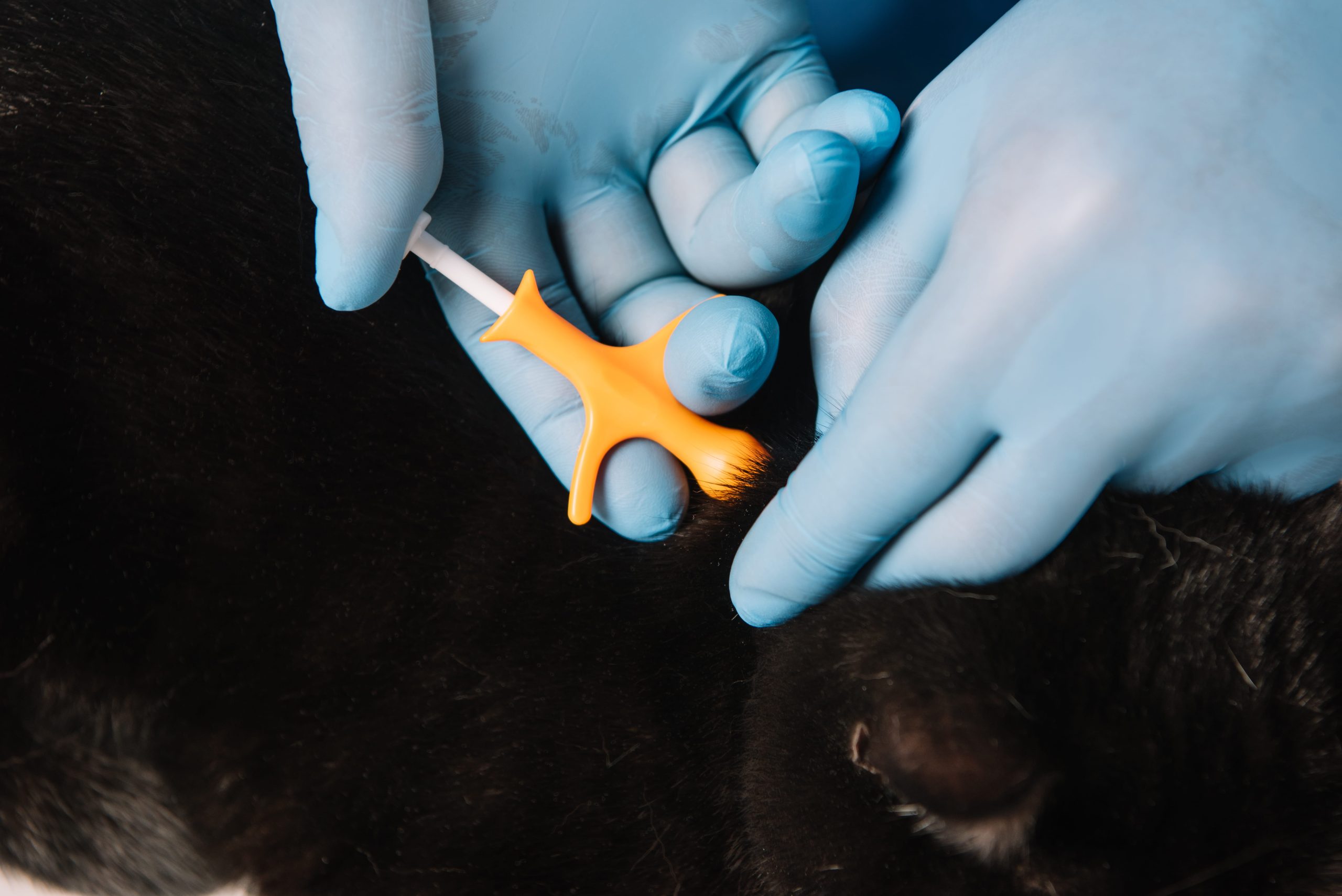
A pet microchip is a small biocompatible transponder, roughly 12mm in length (e.g., a grain of rice), that is placed just under your dog’s skin, typically between the shoulder blades. It contains a unique identification number that can be read using a handheld scanner. Unlike GPS trackers or collars, a microchip does not transmit location or actively send signals. Instead, it uses passive RFID (radio-frequency identification) technology. When a scanner passes over the chip, it briefly activates and transmits its ID number, which is then used to look up your contact details in a microchip registry.
This distinction is important. A microchip is not a tracking device. It is a permanent form of identification that stays with your dog regardless of collars, tags, or travel conditions. However, simply having a chip isn’t enough; for international travel, the specific type of technology inside that chip becomes the deciding factor in whether your pet can cross the border.
ISO vs Non-ISO Microchips: What’s the Difference?
When it comes to international pet travel, not all microchips are treated equally. While several types are used around the world, the key distinction is whether your dog’s microchip meets international ISO standards.
What Is an ISO-Compliant Microchip (ISO 11784/11785)?
An ISO-compliant microchip follows the global standards set by ISO 11784 and ISO 11785. These chips operate at a frequency of 134.2 kHz and are designed to be readable by standardized scanners used internationally.
Most countries require ISO-compliant microchips because they ensure consistency across borders. Whether your dog is scanned at a veterinary clinic, airport, or customs checkpoint, the chip can be reliably detected and matched to its documentation.
For destinations across Europe, the UK, and much of Asia and Oceania, an ISO-compliant chip is effectively mandatory for entry.
What Is a Non-ISO Microchip?
Non-ISO microchips are commonly used in the United States and typically operate at lower frequencies, such as 125 kHz or 128 kHz. While they function perfectly well for domestic identification, they are not always compatible with international scanners.
This creates a potential issue during travel. If a border official cannot read your dog’s microchip, they may not be able to verify vaccination records or import documents—even if everything else is in order.
Why ISO Microchips Are Required for Most Countries
International pet travel relies on one core principle: traceability. Authorities need to confirm that your dog’s identity matches every piece of paperwork submitted, from rabies vaccinations to health certificates.
ISO-compliant microchips make that possible by:
-
Ensuring universal scanner compatibility
-
Providing a consistent identification standard across countries
-
Reducing the risk of misidentification or fraud
In contrast, a non-ISO chip introduces uncertainty. If it cannot be read at any checkpoint, your dog may face delays, additional inspections, or even quarantine.
When to Microchip Your Dog Before International Travel
Timing is one of the most critical and most commonly overlooked parts of the microchipping process. It’s not enough for your dog to simply have a microchip. For international travel, the chip must be implanted before key medical and regulatory steps are completed.
Why Timing Matters for Rabies Vaccination
Most countries require that your dog’s rabies vaccination be administered after the microchip is implanted. This ensures the vaccine can be directly linked to the correct animal through the recorded microchip number. If the sequence is reversed—meaning your dog was vaccinated before being microchipped—the vaccination may be considered invalid for travel purposes. In that case, your dog would typically need to be:
-
Re-microchipped (if necessary)
-
Revaccinated for rabies
-
Restart any required waiting periods
For countries with strict import protocols, this can significantly delay your timeline. For example, destinations like Australia and Japan often require extended waiting periods after rabies vaccinations or blood tests, meaning a simple sequencing mistake can push travel back by months.
What Happens If You Microchip Too Late?
If your dog is microchipped after vaccinations or other documentation has already been completed, those records may no longer be valid. This creates a disconnect between the dog and its paperwork, which border authorities will not accept.
In practical terms, that can lead to:
-
Delayed or denied health certificate approval
-
Repeating vaccinations or lab tests
-
Missed travel dates due to compliance issues
In more serious cases, your dog could be denied entry upon arrival or placed into quarantine until requirements are met.
Do You Need to Register Your Dog’s Microchip Internationally
A microchip on its own doesn’t do anything unless it’s properly registered. The chip only contains a unique ID number—your contact information is stored separately in a database, known as a microchip registry.
When your dog is scanned, that number is used to search a registry and retrieve the associated owner details. If the chip isn’t registered—or the information is outdated—the microchip cannot fulfill its primary purpose: linking your dog back to you.
How Microchip Registries Work
After implantation, the microchip must be registered with a database that stores:
-
Owner name and contact information
-
Emergency contact details
-
Sometimes veterinary or travel-related notes
In the United States, there are multiple registries tied to different chip manufacturers. However, many of these databases are connected through global lookup tools, allowing international authorities to trace a microchip number back to the correct registry.
During international travel, if your dog is scanned, officials will use the microchip number to:
-
Identify the correct registry
-
Pull up owner information
-
Confirm it matches the travel documentation
Choosing a Registry That Works Globally
Not all registries are equally effective for international travel. Some are limited in scope or require additional steps to ensure global visibility.
For travel purposes, you’ll want a registry that:
-
Is searchable through international lookup systems
-
Maintains accurate, up-to-date records
-
Does not restrict access behind paywalls or inactive accounts
It’s also important to keep your information current. If your phone number, email, or address changes, updating the registry should be treated as part of your travel preparation—just like renewing a passport.
How Microchips Are Checked During International Travel
Microchips will be checked at multiple points throughout the travel process. These scans are what allow authorities to confirm that your dog matches the documentation submitted for travel. Understanding where and how these checks happen helps you avoid surprises and ensures everything is aligned before departure.
At the Veterinarian
The first checkpoint happens at your vet’s office. Before issuing any official paperwork, your veterinarian will scan your dog’s microchip to confirm that the chip is present and readable and that the number matches what will be recorded on documents. This step is critical because the microchip number becomes the primary identifier tied to all medical and travel records. Any mismatch here can invalidate paperwork later on.
At the Airport
Depending on the airline and route, your dog’s microchip may be checked during check-in, particularly for international travel or cargo bookings. Airline staff may verify the microchip number against your paperwork and ensure its compliance with destination country requirements. While not every airline performs this check consistently, it’s common enough that you should be prepared for it—especially when traveling with major carriers or through international hubs.
At Customs in the Destination Country
The most important microchip check occurs upon arrival, where border officials or quarantine staff will typically scan your dog to confirm the chip is present and readable, and matches import permits, vaccination records, and health certificates. This is the final verification step. If the microchip cannot be read or does not match the documentation, authorities may delay, deny, quarantine, or potentially require additional verification steps. From start to finish, the microchip acts as the single point of truth, tying your dog to every document in the travel process.
Microchip Requirements by Country
While most countries follow similar principles when it comes to pet identification, the specific microchip requirements and how strictly they’re enforced can vary. Understanding these differences is important, especially if you’re traveling to a destination with more complex import rules. Below are a few examples that illustrate how microchip requirements are applied in practice.
United Kingdom
The UK requires all dogs entering the country to have an ISO 11784/11785-compliant microchip. The chip must be implanted before the rabies vaccination is administered, and the microchip number must be recorded on all supporting documentation. If your dog’s microchip cannot be read upon arrival, entry may be denied or delayed until proper identification can be confirmed. The UK does not typically accommodate non-ISO chips without additional steps, making compliance essential.
Learn more about the UK’s official guidelines on microchips.
France
As part of the European Union’s pet travel framework, France follows standardized EU regulations. Dogs must have an ISO-compliant microchip, and it must be linked to a valid rabies vaccination and an EU health certificate or pet passport. Like the UK, France requires that the microchip be implanted before vaccination. The microchip number is used to verify all documentation at entry points.
Learn more about the EU’s microchip and rabies vaccination requirements.
Australia
Australia has one of the most stringent pet import processes in the world. An ISO-compliant microchip is required at the very beginning of the process and is used to track rabies vaccinations, rabies antibody (RNATT/FAVN) testing, and import permits and quarantine arrangements. Because Australia enforces strict timelines and sequencing rules, any issue with the microchip, whether implanted too late or recorded incorrectly, can delay travel.
Australia offers distinct sets of guidelines for bringing your dog from group 2 countries and bringing your dog from group 3 countries.
Japan
Japan also requires ISO-compliant microchips and places heavy emphasis on sequencing. The microchip must be implanted before rabies vaccinations and rabies antibody testing. Japan’s process includes mandatory quarantine periods after testing, meaning errors tied to microchipping often result in restarting the timeline.
Japan also offers distinct guidelines for importing dogs from “designated” regions and “non-designated” regions.
Across these country examples, a consistent pattern emerges:
-
ISO-compliant microchips are the global standard
-
Timing (implantation before vaccination/testing) is critical
-
The microchip number must match all documentation exactly
While requirements vary in complexity, the role of the microchip remains the same—it is the foundation that ties every step of the international travel process together.
FAQs About Dog Microchips for International Travel
This section pulls together the most common questions pet owners have—especially those that come up when planning international travel.
What is a microchip for dogs and what does it do?
- A microchip is a small implantable device that provides a permanent form of identification for your dog. It contains a unique ID number that can be read with a scanner and used to retrieve your contact information from a registry. It does not track location—it simply links your dog to its records and ownership details.
Do dogs need an ISO microchip to travel internationally?
- In most cases, yes. The majority of countries require an ISO 11784/11785-compliant microchip so that it can be read by international scanners. Without it, authorities may not be able to verify your dog’s identity against its travel documents.
How much does it cost to microchip a dog?
- The cost typically ranges from $25 to $75, depending on the veterinary clinic, location, and whether registration is included. Some shelters and local programs may offer low-cost or free microchipping events.
Can you get your dog microchipped for free?
- Yes, in some cases. Animal shelters, rescue organizations, and local municipalities occasionally offer free or discounted microchipping events, particularly during adoption drives or community outreach programs.
Is microchipping safe for dogs?
- Microchipping is widely considered safe and is a routine procedure performed by veterinarians. Complications are rare, and the benefits of permanent identification generally outweigh the minimal risks.
Is microchipping painful for dogs?
- The procedure is similar to receiving a vaccination. Most dogs experience only brief discomfort during insertion, and no anesthesia is required.
Are there GPS microchips for dogs?
- No, microchips do not provide GPS tracking. They use passive RFID technology and can only be read when scanned. If you’re looking for real-time tracking, that would require a separate GPS collar or device.
Do dog microchips expire or stop working
- Microchips are designed to last for the lifetime of your dog and do not require batteries. While failures are rare, it’s a good idea to have your vet scan the chip periodically to ensure it’s still readable.
How do you register a dog’s microchip?
- After implantation, the microchip must be registered with a database that stores your contact information. This is typically done online using the chip number provided by your veterinarian. Keeping this information updated is essential.
How do you change ownership on a dog’s microchip?
- Ownership can be updated through the microchip registry where the chip is registered. This usually involves logging into the account associated with the chip and updating contact details or transferring ownership to a new person.
How do you find or scan a dog’s microchip number?
- A veterinarian, animal shelter, or rescue organization can scan your dog using a handheld device to retrieve the microchip number. This number is also often included in your dog’s veterinary records.
What if my dog already has a non-ISO microchip?
- If your dog has a non-ISO microchip, you can either implant a second ISO-compliant chip or travel with a compatible scanner (if allowed by the destination country). Most experts recommend adding an ISO chip to avoid complications. But if your pet has two chips, we’d recommend both numbers must be recorded on the health certificate to avoid confusion at the border.
How big is a microchip for a dog?
- A microchip is very small, typically about the size of a grain of rice. It’s implanted under the skin and is not visible externally.
Is there a monthly fee for a dog microchip?
- No, there is no monthly fee for the microchip itself. However, some registries may charge a one-time registration fee or optional subscription services for added features like recovery support.
Take the Stress Out of International Pet Relocation
Navigating microchip frequencies, vaccination timelines, and international import laws can be the most taxing part of your relocation. A single clerical error or a timing mismatch is often the difference between a smooth arrival and an expensive quarantine. At Animal Land Pet Movers, we specialize in the technical nuances of international pet travel, ensuring every chip is scanned, every document is matched, and every deadline is met. Let our experts handle the logistics so you can focus on your own journey. Contact our relocation team today for a personalized travel consultation.