
The Eurotunnel remains the calmest way to cross the Channel with a pet: your dog or cat stays in the car with you for the whole 35-minute crossing, with no separate animal hold and no time apart. The service itself has barely changed. The paperwork behind it has changed completely. Since Brexit, the EU Pet Passport issued in Great Britain no longer works, and most owners now travel on an Animal Health Certificate instead. This guide covers what your pet actually needs for Eurotunnel travel in 2026, in the correct order, with the timing that trips people up.
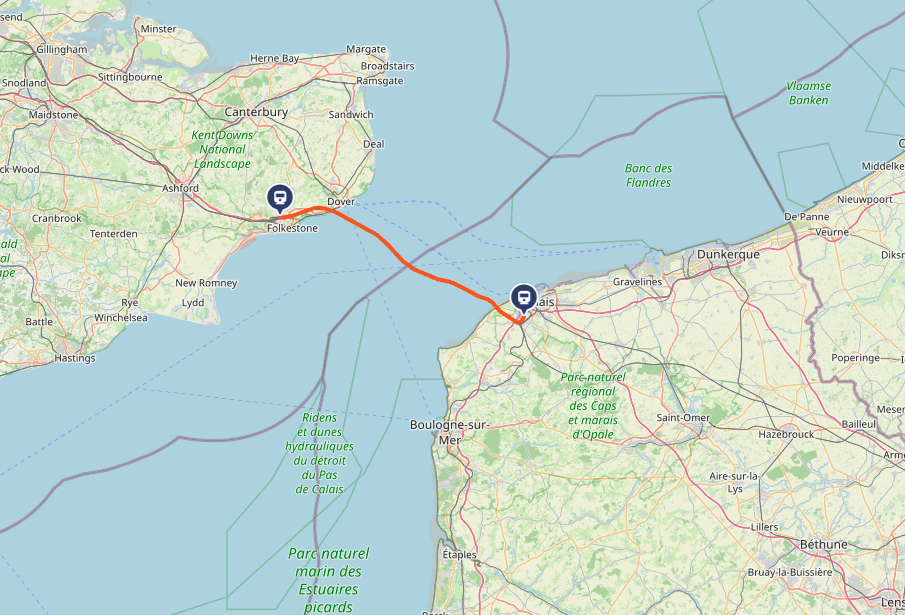
First, a naming note. The Channel Tunnel car-carrying service is officially branded LeShuttle (formerly Eurotunnel Le Shuttle). It is the drive-on shuttle that carries cars through the tunnel between Folkestone and Calais. It is not the Eurostar passenger train, which does not accept pets except registered assistance dogs. If you want to bring your dog or cat, LeShuttle is the Channel Tunnel option.
Can I Take My Dog or Cat Through the Eurotunnel?
Yes. Dogs, cats and ferrets travel on LeShuttle, staying inside your vehicle for the entire crossing. LeShuttle reports having carried over 5 million pets, and the service runs every day of the year. There is a dedicated Pet Reception at the Folkestone terminal and a drive-through Pet Reception on the Calais side, where staff scan your pet’s microchip and check the documentation before you board. Read more about LeShuttle pet travel requirements.
The Eurostar passenger train is the one exception worth repeating: it does not carry pets other than registered assistance dogs. If you do not have a car, you would need a pet-transport service that drives you and your pet through on LeShuttle.
What Documents Does My Pet Need to Cross the Channel?
The requirements differ by direction of travel, and getting the direction right matters because the documents are not interchangeable.
Traveling from Great Britain to France (and the EU)
Since 1 January 2021, EU Pet Passports issued in Great Britain are no longer valid for travel from England, Scotland or Wales into the EU. Instead, most GB pet owners now need an Animal Health Certificate (AHC), issued by an official veterinarian. According to the UK government, one AHC can cover up to five pets, and it must be issued within 10 days of the date your pet enters the EU. Day one is the date the certificate is issued.
An AHC is single-use for the outbound crossing. It remains valid for onward travel within the EU for four months and for re-entry to Great Britain during that period, but a new certificate is required for each new trip out of GB. Learn more about taking your pet abroad.
Traveling from the EU to Great Britain
For entry into Great Britain, LeShuttle accepts any one of the following: a valid EU Pet Passport (or one issued in an approved country), an Animal Health Certificate issued in Great Britain within the last four months, a Great Britain pet health certificate, or a pet passport issued in Great Britain before 1 January 2021.
What Are the Core Pet Travel Requirements?
Whichever direction you travel, the underlying health requirements are the same, and the order in which you complete them is not optional.
- Microchip first. Your dog, cat or ferret must be microchipped so it can be matched to its documentation. LeShuttle notes that a tattoo is accepted only if it was applied before 3 July 2011. The microchip must come before or at the same time as the rabies vaccination.
- Rabies vaccination second. The pet must be at least 12 weeks old before it can be vaccinated, and must already be microchipped. If the vaccine is given before the chip, it does not count and must be done again.
- Wait for the vaccine to become valid. You must wait at least 21 full days after the first vaccination (or the final dose of the initial course) before traveling. Day one is the day after the vaccination. Some vaccines require longer, so confirm with your vet.
- Get the travel document. The AHC (or accepted alternative) is issued once the rabies vaccination is valid.
- Tapeworm treatment for dogs entering the UK. Covered in detail below.
The most common mistake: microchipping a pet after the rabies vaccination. When the order is reversed, the vaccination is invalid and the 21-day clock starts over from a new shot. This is the same ordering rule that governs pet travel worldwide, and it is worth triple-checking before anything else. See our guide on what to know about microchips for dogs and international travel.
Do Dogs Need Tapeworm Treatment for the Eurotunnel?
Yes, for dogs entering Great Britain. Before you travel to the UK, a vet must treat your dog for tapeworm (Echinococcus multilocularis). LeShuttle and the UK government both specify that the treatment must be given between 24 and 120 hours (1 to 5 days) before your scheduled arrival in the UK, and the vet must record the date and time in your pet’s documentation.
Two details matter. The treatment must contain praziquantel to be accepted. LeShuttle explicitly notes that some common products, including Stronghold, Advocate, Frontline, Frontline Combo, NexGard and NexGard Spectra, do not meet this requirement. And the treatment applies to dogs only: cats and ferrets are exempt from the tapeworm rule.
For short round trips, the timing needs care. If you leave Great Britain and return within 5 days, your dog can be treated before you go, but you must then wait 24 hours after treatment before re-entering GB and return within 120 hours of the treatment. If your dog does not meet these windows, it will not be able to travel.
How Does Pet Check-In Work at the Terminal?
LeShuttle asks that you arrive in good time for the pet check-in. Its Pet Reception at Folkestone is open 24 hours a day: in the UK you park and walk into the terminal, and in France you follow signs to a dedicated drive-through Pet Reception. Staff scan the microchip and confirm it matches the number on the documentation, then check the AHC or passport. Both terminals have pet exercise areas so your dog can stretch before the crossing.
Once checked in, you drive onto the shuttle and stay with your pet in the vehicle for the crossing. There is no separate pet area, which is exactly why so many owners prefer this route over flying or a ferry.
Is the Eurotunnel Better Than Flying for My Pet?
For travel between Great Britain and nearby Europe, many owners find the crossing far less stressful than air travel, because the pet stays with them the entire time rather than traveling as cargo. It suits road trips, short relocations, and owners who want to remain with their pet throughout.
It is not the answer for every move. If you are relocating from the United States, or anywhere that requires a long-haul flight, your pet will still fly to reach Europe, and the Channel crossing is only the final leg. Long-distance and intercontinental relocations involve cargo bookings, kennel compliance and destination import rules that go well beyond a Channel crossing. Our Ultimate Guide to Pet Cargo and Air Freight for Dogs and Cats covers how that works.
Planning a UK or EU Move With Your Pet?
The Channel crossing is straightforward once the paperwork is right, but the paperwork is where UK and EU moves go wrong: the microchip-then-rabies order, the 21-day wait, the 10-day AHC window, and the 1-to-5-day tapeworm window for dogs all have to line up against a single travel date. Miss one and the trip is delayed.
For a fuller picture of moving to and from the UK, see our expert tips for pet relocation to the United Kingdom, and for the wider timeline that governs any international move, our International Pet Relocation Timeline.
Moving farther than the Channel? Request a price quote and our pet relocation specialists will map the full route, requirements and timeline for your pet’s move, from the flight to Europe through to the final Channel crossing.
Pet travel rules, time windows and accepted document types are set by the UK and EU authorities and are updated from time to time. Requirements described here were verified against LeShuttle and GOV.UK guidance in July 2026 and are provided for general information only. Always confirm current requirements with GOV.UK and LeShuttle before booking vet appointments or travel.